| |

|
|
Sprint
Convergence |
MPLS is the
core of Sprint’s convergence strategy, enabling voice,
video and data via a single IP connection so businesses
can reduce costs, improve employee productivity and
streamline their network. MPLS also offers a flexible
network foundation that scales for growth and allows for
easier adoption of next generation technologies
including Unified Communications.
Products include: |
- MPLS Domestic –
Sprint earned the highest Ranking overall for IP
Network Reliability from Nemertes in 2009
- MPLS International –
Expansion in Canada, Philippines and India
- Voice is Back!
Outbound & Inbound for new and existing customers,
must have data component
- DIA
- Ethernet Access
Expansion – Building out in existing 21 Markets, 41
New Markets planned
- SIP Trunking
-
Sprint Mobile
Integration (SMI) – Works with a wide variety of
PBXs beyond Cisco and Avaya
due to launch with Tango
Sprint has the assets to uniquely enable customers
to fully integrate their Sprint CDMA phones with the
unified communications environment via Sprint Mobile
Integration. An
innovative, IP-based fixed mobile convergence (FMC) solution, Sprint Mobile Integration allows enterprises to
extend the capabilities of a PBX or UC system
to their employees' Sprint mobile phone.
- Managed Services and
Security – Numerous options to fit any company
- Wireless, M2M,
Mobility and hundreds of applications on the
nation's only 4G network
- Integrated
Conferencing Enablement (ICE) Reduce Conferencing
costs by as much as 30%
|
|
No Other Provider Offers
This Service!
Contact CMS now to find out about this
HOT
New Service |
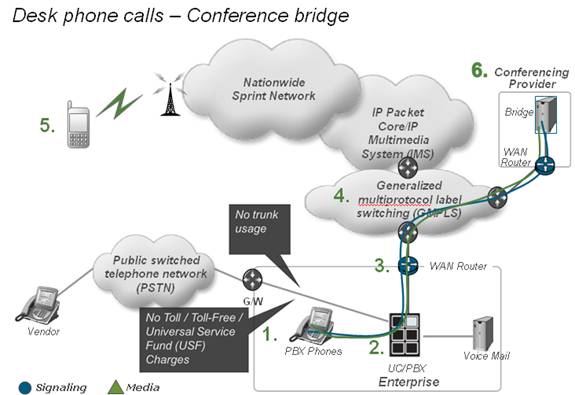
Enables
customers to cut costs by connecting their conference
bridge solution via Session Initiated Protocol (SIP) vs.
Time-Division Multiplexing (TDM) from:
> Enterprise – Routes
toll-free (TF) or toll calls over Sprint Multiprotocol
Label Switching (MPLS)
to an InterCall conference bridge or
premise-based conference bridge
> Wireless device integrated
with Sprint Mobile Integration – Routes the TF
or toll call over
Sprint MPLS to the bridge provider as
an on-network call
Benefits:
Eliminates/reduces toll/toll-free calls to conference
bridge
Potential reduction of conference call costs by
terminating to IP vs. TDM – case by case basis
Reduces costs because of waived USF charges from
InterCall (USF & taxes are approximately 20%)
Significantly reduces number of PRIs used for conference
bridge calls (reduced further with SMI
&
SIP Trunking)
Inherent redundancy built into MPLS solution in the case
of a WAN failure
|
 |


|
|